-1.png?width=3330&height=698&name=TGP%20International%20Logo%20White%20(1)-1.png "TGP International logo")
.jpg?width=970&height=743&name=Kontraloop%20-%20PR_35%20(1).jpg)
Interior Design,
Operational Management,
Cafe & Bakeries,
UAE,
Marketing,
Brand & Concept Development
Over the last decade, the silos that once defined our urban environments have steadily dissolved, giving way to a more integrated way of living and working.
While the blending of sectors has been a gradual trend, the rate of hybridisation has accelerated sharply in recent years, propelled by a global shift in what we want from our physical environments and how we spend our time. Rigid distinctions of the past century have now given way to many instances of fluid, multi-purpose "third spaces" that refuse to be neatly categorised.
INTRODUCTION
Across global cities, spaces are being asked to do more. A café becomes a workspace in the morning, a social hub by afternoon, and a bar by night. A hotel lobby doubles as a neighbourhood living room. A market hall hosts events, exhibitions and informal meetings alongside food.
While hybridisation is not entirely new, the scale and intentionality behind it have accelerated. This shift appears driven by a combination of economic pressure, changing lifestyles, and a growing preference for environments that prioritise experience and connection.
Within this evolution, food and beverage has emerged as a particularly powerful anchor. Not because it replaces other functions, but because it naturally intersects with them, providing rhythm, hospitality and a shared human constant in increasingly blended environments.
Key Takeaways:
|
Trend / Insight |
Key Insight / Data |
|
Higher Asset Resilience |
Mixed-use developments with F&B and lifestyle elements typically command a 10–15% premium in valuation compared to single-use assets, driven by diversified revenue streams. |
|
The "Halo Effect" |
Integrated F&B acts as a primary anchor; successful food halls and markets increase surrounding retail footfall by up to 22%. |
|
Maximising "Dead Time" |
Venues transitioning from daytime (co-working/café) to nighttime (bar/dining) can see a 30–40% increase in spatial efficiency, capturing revenue across 18 hours instead of 6–8. |
|
Lower Risk Profiles |
90% of restaurant operators in 2026 seek at least one additional revenue stream (e.g., retail products, virtual brands, subscriptions) to hedge against market volatility. |
|
Experience Over Transaction |
85% of consumers report that digital convenience (mobile ordering/payments) and atmosphere matter more than specific menu items when choosing a venue. |
|
The Rise of the "Third Space" |
32% of professionals now spend at neighbourhood "commuter hubs," driven by structural remote and hybrid work, increasing demand for multi-role venues outside city centres. |
|
Intentional Spending |
Consumers go out less frequently but spend more per visit; premium dining visits up 8%, while mid-range single-purpose restaurants decline nearly 27%. |
|
The "Work-from-Pub" Trend |
Over 70% of Gen Z and Millennial workers prefer hybrid hospitality environments (cafés, hotel lobbies with Wi-Fi/power) over traditional offices. |
|
AI as an Enabler |
By 2026, AI-driven forecasting is standard among top operators to manage complex staffing for venues that shift roles throughout the day. |
|
Sustainability as Standard |
66% of diners actively seek venues with visible sustainable credentials (low waste, local sourcing), making green design key for long-term tenant retention. |
Cities Are Being Rebuilt Through Reuse and Convergence
One of the most visible expressions of hybridisation is adaptive reuse. Former warehouses, factories, transport hubs, and civic buildings are being reimagined as mixed-use destinations that combine hospitality, retail, workspaces, and cultural programming.
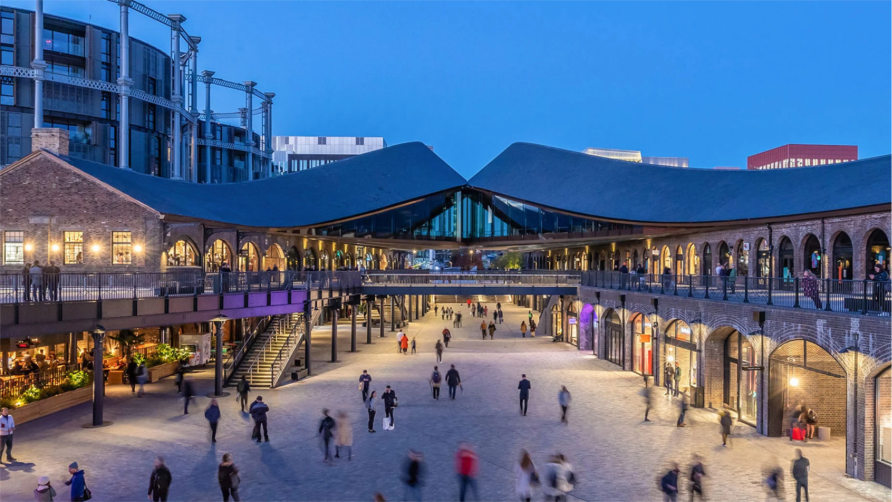
- Coal Drops Yard, London: This transformation of two Victorian coal drops into a "shopping and restaurant district" is a masterclass in the blur. By integrating high-end retail with communal dining and event-led public realms, it has turned a derelict industrial site into a social "third space" that functions as much as a park as it does a commercial hub.
- Battersea Power Station: Perhaps the most ambitious UK example, this iconic Grade II* listed landmark now houses Apple’s London Campus alongside hundreds of shops and the Control Room B cocktail bar. The integration of 58,000m² of office space with leisure and residential units ensures the site remains active 24/7, moving away from the "commuter-only" identity of traditional business districts.
- Mercato Mayfair: Housed within the Grade I listed St. Mark’s Church, this site proves that even historic civic architecture can be repurposed. It functions as a sustainable community market, a cultural hub, and an F&B destination, proving that spiritual or civic heritage can coexist with modern hospitality.
In many cities, this approach is less about nostalgia and more about pragmatism. Reuse can offer speed to market, sustainability benefits (by retaining embodied carbon), and a sense of authenticity that ground-up developments sometimes struggle to replicate. That said, adaptive reuse is not universally applicable; structural limitations, heritage constraints, and operational complexity can make it unviable in certain contexts.
Alongside reuse, mixed-use development has become the dominant planning model for new urban projects. Data from the Tall Buildings Survey 2025 confirms this shift, showing that nearly eight in ten of London’s newest tall-building projects are now mixed-use rather than single-purpose. Residential towers integrated with retail podiums, hospitality offerings, and curated public realms are the default.
While the degree of success varies by market, there is growing global evidence that convergence is no longer a fringe concept. In regions undergoing rapid urban transformation, such as Saudi Arabia, mixed-use functionality is being baked into the "Giga Projects" at a scale never before seen.
Diriyah Gate (Riyadh): This $63bn heritage-led development is reimagining the ancestral home of the Saudi state. It blends ultra-luxury hospitality and high-end residential with over 450 global retail brands and a dedicated "Fine Dining District." Here, F&B acts as the bridge between ancient Najdi history and a modern, lifestyle-focused future.
These projects represent a shift from "mixed-use buildings" to "mixed-use territories." They treat hospitality less as a sector and more as an operating system that runs through the entire urban fabric.
Why Flexibility Is Now a Commercial Imperative
Beyond lifestyle trends, flexibility has taken on clear commercial significance. Mixed-use, lifestyle-led districts often command a financial premium, driven by higher footfall, extended dwell time and diversified revenue streams.
From a developer perspective, multi-purpose environments can offer resilience against market volatility. When one use underperforms, another may compensate. However, this is not without risk, complexity in design, leasing and operations can offset some of the perceived benefits if not carefully managed.
Flexibility also has experiential value. Spaces that evolve throughout the day feel alive, relevant and responsive. For consumers, this adaptability can translate into loyalty, not necessarily to a single brand, but to a destination that consistently meets different needs.
That said, flexibility should not be mistaken for neutrality. The most successful hybrid environments tend to have a clear underlying identity, even if their uses shift over time.
Explore Our Advisory Services For Mixed-Use And F&B-led Developments
F&B as the Anchor of Hybrid Districts
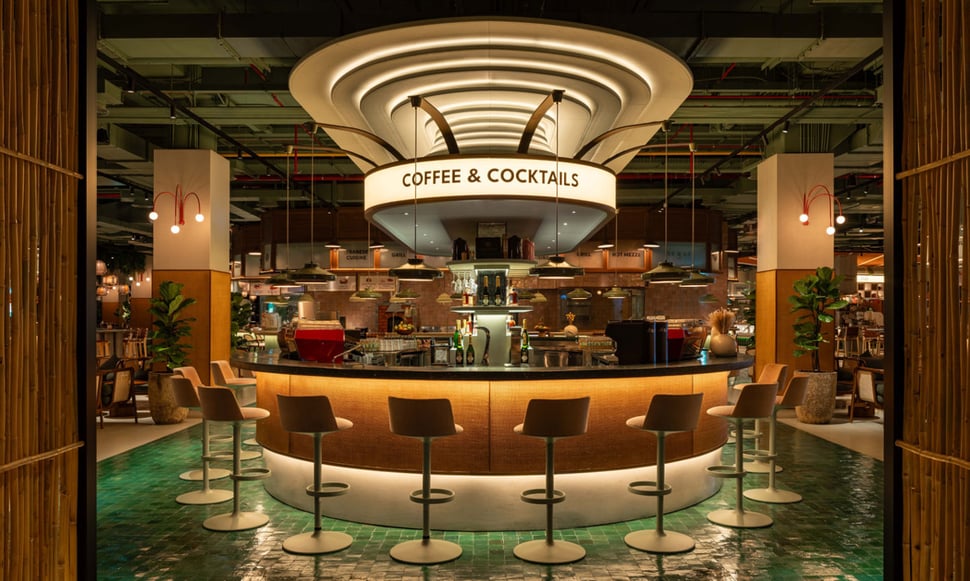
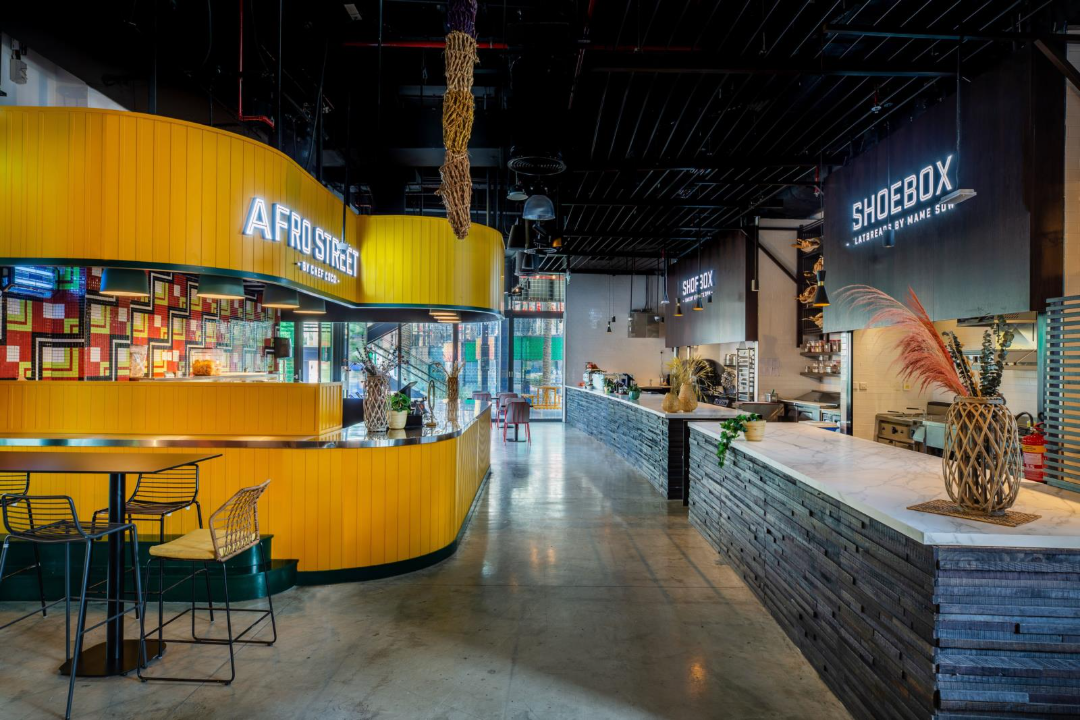
Food halls, markets and dining clusters have become central features of many hybrid developments, particularly within malls, mixed-use destinations and large-scale urban projects. Their appeal lies partly in their social function: eating is inherently communal, and these formats create natural points of gathering that encourage interaction, discovery and shared experience. By combining quality, variety and informality, food halls offer a more dynamic alternative to traditional dining formats, aligning closely with how people want to spend time today.
Globally, food hubs have played an increasingly influential role in placemaking. From revitalising underused districts to establishing new neighbourhood identities, they often act as catalytic assets at both launch and maturity stages of a development.
Their multi-vendor structure creates low-barrier entry points for a wide demographic, attracting residents, workers and visitors alike, while encouraging exploration beyond the food hall itself. When executed well, they generate a halo effect, increasing footfall and dwell time across surrounding retail, leisure and public spaces, and strengthening the destination’s overall performance and reputation.
While F&B’s ability to drive footfall and dwell time is well documented, its softer impact can be just as significant. Restaurants, cafés and bars contribute disproportionately to the emotional memory of a place, shaping how it feels, how long people stay, and whether they return.
Food halls, in particular, support social cohesion by offering inclusive environments where different age groups, cultures and usage patterns can coexist across the day. This makes them especially effective within hybrid developments that must serve multiple audiences without fragmenting identity.
However, food is not a guaranteed solution in itself. Oversaturation, lack of differentiation or formats imported without sensitivity to local context can quickly erode value. Even high-quality food halls can underperform if they are treated as standalone attractions rather than integrated components of a wider ecosystem. Anchoring works best when F&B is aligned with broader placemaking goals, supporting lifestyle programming, reinforcing cultural relevance and adapting over time rather than relying on novelty alone.
When thoughtfully integrated, food halls and dining clusters move beyond consumption to become social infrastructure: flexible, high-performing assets that support both commercial outcomes and long-term place identity.
See How Our Design Team Creates Flexible, Experience-led Hospitality Spaces
The Rise of Day-to-Night and Multi-Role Venues
One of the clearest manifestations of blurred formats is the rise of venues designed to change character across the day. Cafés that transition into wine bars. Hotel lobbies that operate as co-working spaces. Restaurants that host talks or pop-ups outside peak dining hours.
These models maximise spatial efficiency and respond to changing consumer rhythms. They also challenge traditional notions of branding, success is less about a single defining moment and more about continuity of experience.
However, not every venue benefits from constant transformation. Some concepts rely on ritual, predictability or a strong singular identity, where familiarity and consistency are central to the guest relationship. In these cases, excessive flexibility or over-programming can dilute brand clarity rather than enhance it.
The opportunity lies in understanding when fluidity strengthens the experience, and when it undermines what makes a concept distinctive.
That said, we have seen across many of our venues, including Seed & Bloom, how all-day dining formats and considered day-parting strategies can meaningfully extend a venue’s relevance without compromising identity. By allowing the same space to evolve naturally from morning coffee and casual meetings, to daytime dining, and into more social evening use, these formats activate the venue across longer trading hours and for multiple audiences. The key is not constant reinvention, but calibrated shifts in menu, lighting, service style and atmosphere that feel intentional and coherent.
When flexibility is embedded into the original concepts, rather than applied reactively, it enables venues to capture broader demand while maintaining a clear point of view. Day-parting becomes a tool for inclusion and commercial resilience, supporting different rhythms of use across the day while reinforcing, rather than fragmenting, the brand experience.
Read About Our Seed & Bloom Project
Hospitality Beyond Hospitality
Hospitality principles are increasingly being adopted beyond traditional hospitality settings. Retail environments borrow from hotel design to create comfort and service-led experiences. Residential developments incorporate concierge-style amenities and social programming. Cultural institutions elevate their F&B offerings as part of the visitor journey.
Explore More On Why Fashion Is Investing In F&B
Designing for Inclusivity and Cross-Generational Use
There is also growing awareness of neurodiversity and intergenerational needs in hospitality. Neuroinclusive design, an approach that enables individuals across the sensory spectrum to coexist comfortably, is being adopted through strategies like quieter zones, acoustic zoning, and clearer wayfinding, which improve comfort for diners who might otherwise avoid high-stimulus settings.
Some venues are already leading the way: The Lighthouse Restaurant at the Fullerton Hotel Singapore introduced adjustable-height dining tables and accessible seating to enhance comfort for guests with mobility needs, while inclusive concepts like HAGS in Manhattan blend thoughtful design with community-centric policies that broaden accessibility.
Inclusive design also has a measurable business rationale: hospitality operators that prioritise accessibility and sensory comfort can tap into new guest segments and strengthen brand loyalty, helping drive sustained visitation rather than one-off experiences.
Explore How Our Marketing Team Builds Relevance And Long-term Loyalty
The Challenge of Achieving Hybrid Functionality
- Operational complexity is the hidden challenge
Hybrid environments may feel effortless to guests, but behind the scenes they require highly coordinated planning, particularly in F&B, where uses, volumes and expectations shift throughout the day. - Flexible infrastructure is essential, but not sufficient
Modular kitchens, shared prep spaces and integrated back-of-house systems enable adaptability, but they only work when operators, designers and landlords are aligned from the earliest stages. - People and process matter as much as physical design
Staff training, service models and brand narratives must flex without fragmenting. When alignment falters, operational strain quickly becomes visible to guests. - Seamlessness is the true measure of success
When hybrid functionality is executed well, the complexity disappears, creating experiences that feel intuitive rather than engineered. - F&B often acts as the catalyst for hybrid developments
Food and drink can generate early buzz, attract first adopters and help activate emerging districts during launch phases. - Sustaining relevance is harder than creating momentum
Long-term placemaking depends less on constant activation and more on stewardship, consistency and a clear sense of purpose. - Programming supports places, but coherence sustains them
Pop-ups and events can maintain energy, but novelty must be balanced with identity to avoid dilution. - Hospitality’s role evolves over time
Beyond the opening moment, successful hospitality shifts from spectacle to support, embedding itself into the everyday life of a place.
Learn How Our Operations Team Aligns Design Intent With Real-World Performance
Our Perspective and Designing for the Blur
At TGP International, blurred formats are approached as a condition to design within. Across global markets, this means balancing creativity with commercial viability, and ambition with operational intelligence.
Rather than imposing a single model, TGP’s approach considers local culture, regulatory context and long-term operational realities. Partnerships, between developers, operators, brands and communities, are seen as foundational.
